
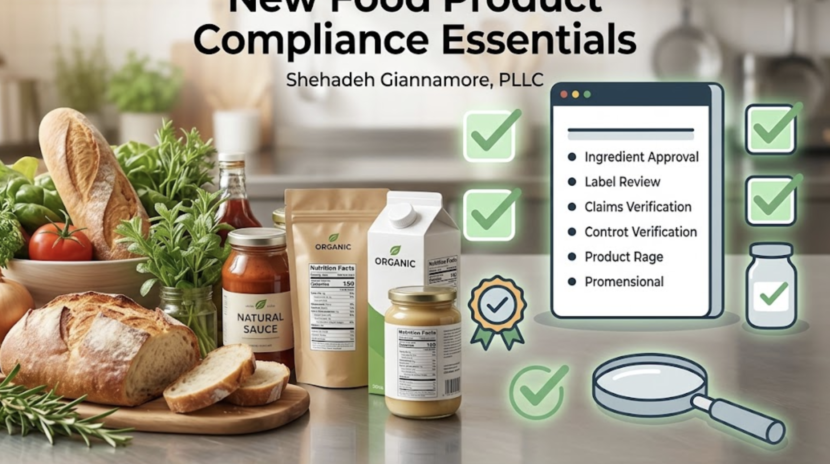
Food startup founders benefit from FDA consultant review before launch. Ingredient legality, label compliance, and marketing claims each carry separate regulatory risk. Shehadeh Giannamore, PLLC reviews products and marketing materials before market entry, helping companies avoid warning letters, import alerts, and costly recalls tied to noncompliant labeling or unsubstantiated claims.
Key Takeaways
- FDA compliance requirements vary by food type, including specific rules for low-acid canned foods, seafood, and juice products.
- Regulatory non-compliance risks costly brand damage and failed product launches in the food industry.
- Our firm specializes in FDA consulting for small businesses and startups developing FDA-regulated food products.
- Proper compliance preparation prevents expensive setbacks during product development and FDA audit processes.
Why Does Your Food Launch Need FDA Review?
FDA review protects a new product before manufacturing dollars, packaging runs, and retail commitments turn a labeling error into a costly recall. A mislabeled ingredient statement or an incomplete submission can trigger warning letters, significant delays, or a product pulled from shelves after launch. Catching these problems early, through pre-launch FDA review, costs far less than fixing them after distribution begins.
We built our practice around this exact risk. Shehadeh Giannamore, PLLC is a boutique firm that concentrates on FDA-related compliance and enforcement matters. We have guided food and beverage companies toward new food product compliance both nationwide and internationally since 2012. Our clients tend to be small businesses and startups developing products. Marketing claims for the first time — the exact moment when regulatory missteps are most common and most preventable.
What does an FDA review actually check?
An FDA review examines the elements regulators scrutinize most: ingredient legality, label accuracy, nutrition claims, and marketing language. We apply a working food product regulatory checklist across categories, including:
- Ingredient sourcing and permitted use status
- Nutrition Facts panel accuracy
- Structure/function and health claim language
- Registration and facility listing obligations
Who handles this kind of review?
Our regulatory counsel spans every FDA-regulated product category, covering everything from pre-market review to enforcement defense. That range matters for founders launching food or beverage products who may later expand into supplements or cosmetics. One relationship, built at the start, carries a brand through each regulatory stage that follows.
What Regulatory Requirements Apply Before You Launch?
Federal law imposes several layers of scrutiny on new food and beverage products before they reach store shelves. We build our pre-launch FDA review around six core areas: ingredient reviews, label reviews, nutrient content claims, organic and natural claims, allergen compliance, and FSMA guidance. Each area carries its own risk if overlooked. Gaps in any one of them can stall a launch date or trigger a recall after the product is already on shelves.
Not every rule applies equally to every business. Some obligations touch all food companies regardless of product type, while others depend entirely on what a business actually makes. Low-acid canned food, seafood, and juice each carry distinct regulatory demands beyond the baseline requirements.
Does my product type change which rules apply?
Yes — the applicable requirements shift based on the specific product and the type of facility used to produce it. A shelf-stable snack food faces different scrutiny than a refrigerated beverage or a canned soup. We tailor our food product regulatory checklist to the product category and manufacturing setup, rather than applying a one-size-fits-all template.
What other services support a compliant launch?
Beyond reviewing ingredients, labels, and claims, we also handle registration and listing services for new products entering the market. These filings work alongside our broader regulatory and legal offerings to give founders one coordinated path to compliance.
Building new food product compliance into development early, rather than treating it as a final checkbox, saves founders from costly rework. Waiting until packaging is printed to ask regulatory questions almost always costs more than asking them at the formulation stage.
What Questions Signal You Need Regulatory Guidance?
Three recurring questions tell us a founder needs regulatory support before launch. Ingredient approval, label accuracy, and marketing claims form the core of every new food product compliance review we conduct. When these questions surface during product development, waiting until after launch to answer them carries real risk.
Are My Ingredients Actually Approved for Use?
Founders preparing a pre-launch FDA review often start here, and for good reason. An unapproved additive or an ingredient lacking recognized safety status can halt distribution entirely, regardless of how strong the formula performs in testing. We treat this question as the starting point of any sound food product regulatory checklist.
Does My Nutrition Facts Label Hold Up to Scrutiny?
Accuracy on the Nutrition Facts Label is the second question we hear most. Serving sizes, rounding rules, and nutrient declarations all carry specific formatting requirements. An inaccurate label invites scrutiny that a compliant one simply avoids.
Beyond ingredients and labeling, founders ask a third question just as often: are the claims on my packaging and marketing materials compliant? A product might be perfectly formulated and labeled, yet still run into trouble because of language on the front panel or a website description that oversteps regulatory boundaries.
These three concerns rarely arrive one at a time. Founders tend to raise them together, often after a formula is finalized but before packaging goes to print. Attorney Katherine Giannamore handles this full spectrum of regulatory work, including:
- Ingredient reviews to confirm approved status
- Label reviews for Nutrition Facts accuracy and formatting
- Reviews of marketing materials, including websites, brochures, and video advertisements
Recognizing these questions early — rather than after a retailer or regulator raises them — keeps a product launch on schedule and off a warning letter list.
What Does a Pre-Launch FDA Review Include?
A pre-launch FDA review examines product formulation, packaging, and marketing materials before a single unit reaches a retail shelf. Our firm built this service to catch compliance gaps while a founder can still fix them cheaply. Not after a warning letter arrives. Skipping this step leaves emerging brands exposed to relabeling costs, distribution delays, and enforcement action that a short review could have prevented.
We designed our new food product compliance consulting specifically for small businesses and start-ups still shaping their products and marketing. Working with a young company at the development stage means we can shape claims. Labels before a brand invests in packaging runs or a national rollout.
What Gets Checked During the Review?
Our reviews run against a documented food product regulatory checklist covering several core areas:
- Ingredient reviews, confirming each component’s regulatory status
- Label reviews, checking format and required disclosures
- Nutrient content claims
- Organic and natural claims
- Allergen compliance
- FSMA guidance relevant to the specific food category
Each item on this list addresses a distinct area where regulators frequently find violations. We treat the checklist as a floor, not a formality.
Who Handles the Review Process?
Katherine Giannamore and Shehadeh Giannamore, PLLC have supported food and beverage companies, along with dietary supplement, cosmetic, medical device, and OTC drug businesses, in achieving FDA compliance since 2012. That work has spanned clients nationwide and internationally.
We approach a pre-launch FDA review as a single coordinated process, not a checklist exercise completed in isolation. Formulation, labeling, and marketing claims all interact. A compliant ingredient can still trigger a violation if the label overstates its function. Reviewing everything together, before launch, gives founders one clear compliance picture instead of scattered fixes made under deadline pressure.
How Should You Get Started With Counsel?
Early conversation with regulatory counsel sets the foundation for a compliant launch. Waiting until a formula, label, or marketing claim is finalized costs founders time and money they cannot easily recover. A regulated food or beverage launch carries stakes that are exponentially higher than an unregulated product launch. One misstep in labeling or ingredient approval can stall commercialization for months.
We built our practice around this reality. Federal food regulations are dense, layered, and constantly changing, which makes a do-it-yourself approach risky for founders without regulatory training. Reading agency guidance documents in isolation rarely reveals how the rules apply to a specific formula, package, or claim.
What should a founder ask during an initial consultation?
Founders benefit most from a candid conversation about their product category, target claims, and launch timeline. We recommend bringing early answers to questions such as:
- What ingredients and sourcing does the formulation use?
- What claims will appear on the label or in marketing materials?
- What is the target launch date, and what production milestones come before it?
- Has any version of the label, packaging, or website copy already been drafted?
How quickly can counsel respond once contacted?
Timing matters when a product launch is on the calendar. Our firm can be reached seven days a week by phone or by email. We strive to respond to every inquiry within 24 hours.
Founders who want to understand how new food product compliance review, a pre-launch FDA review, or a tailored food product regulatory checklist applies to their specific product can contact us directly to start that conversation before production decisions lock in.
FAQ
Do you need an FDA consultant before launching a new food product?
Food startup founders benefit from FDA consultant review before launch. Ingredient legality, label compliance, and marketing claims each carry separate regulatory risk. Shehadeh Giannamore, PLLC reviews products and marketing materials before market entry to help avoid warning letters, import alerts, and costly recalls.
What does an FDA review actually check?
An FDA review examines ingredient sourcing and permitted use status, Nutrition Facts panel accuracy, structure/function and health claim language, and registration and facility listing obligations. This checklist catches the elements regulators scrutinize most before a product reaches shelves.
Yes, FDA compliance requirements vary by food type. Low-acid canned foods, seafood, and juice products each carry distinct regulatory demands beyond the baseline requirements that apply to all food companies.
Conclusion
In closing, engaging FDA regulatory expertise before launching a new food product represents a strategic investment in compliance and market success. The regulatory landscape demands precision, and early consultation with experienced counsel identifies potential obstacles, streamlines your development process, and protects your business from costly enforcement actions. Shehadeh Giannamore, PLLC stands ready to guide startups and established companies through this complex terrain, ensuring your product reaches consumers safely and lawfully.