

FDA consultants and food and drug attorneys both guide product compliance, but their scope, authority, and legal protection differ sharply. A food and drug attorney provides privileged legal representation before the FDA, including enforcement defense, while an FDA consultant offers regulatory guidance on compliance without attorney-client privilege or authority to act for your company. Knowing which adviser your situation requires saves time, money, and in some cases market access.
Attorney Katherine Giannamore of Shehadeh Giannamore, PLLC concentrates her practice on food and drug law, handling ingredient reviews, label reviews, marketing reviews, and warning letter responses under legal privilege. This guide explains what each adviser actually does, where the responsibilities split, and how to decide which one your product needs right now.
Key Takeaways
- A food and drug attorney provides legal representation and defense during FDA enforcement actions and litigation.
- An FDA consultant offers strategic guidance on compliance requirements under the Food, Drug, and Cosmetic Act without attorney-client privilege.
- Only licensed FDA legal counsel can assert privilege, negotiate with the agency’s legal division, and represent your business in a dispute.
- Legal teams often combine attorney expertise with consultant support for complex regulatory strategy and trial preparation.
- Boutique FDA law firms serve small businesses and startups navigating product development and marketing compliance.
Side-by-Side: Where the Two Roles Differ
The fastest way to see the split is to compare what each adviser is actually empowered to do.
| Dimension | FDA Consultant | Food and Drug Attorney |
| Primary focus | Regulatory guidance and process | Legal compliance and defense |
| Attorney-client privilege | No | Yes |
| Representation before FDA | Supportive only | Full legal authority |
| Enforcement defense | Technical support role | Leads the response |
| Typical deliverables | Ingredient, label, and registration reviews | Legal opinions, warning letter responses, litigation strategy |
| Best for | Routine, pre-market compliance work | Disputes, enforcement risk, high-exposure decisions |
Why Does Choosing the Right Adviser Matter?
Adviser selection determines whether a product launch stays on schedule or stalls in regulatory limbo. Companies that treat a food and drug attorney as interchangeable with a compliance consultant often discover the gap too late. A warning letter or an import detention has already disrupted operations. That gap costs time, money, and sometimes market access altogether.
The choice between consultants and attorneys is significant. It shapes compliance outcomes, operational efficiency, and cost. Not as a minor administrative detail, but as a decision with lasting consequences. Getting it wrong means paying twice: once for the wrong guidance, and again to fix what that guidance missed.
The Cost of Choosing Wrong
Misaligned advice shows up in predictable places: labels that draw FDA objections after printing runs, marketing claims that trigger substantiation demands, and registration filings that lapse because nobody owned the renewal calendar. Each of these problems is cheaper to prevent than to repair. A consultant-level review catches most of them early. The problems that slip through, however, tend to be the ones with legal exposure attached, and those require an attorney to resolve.
What Does a Food and Drug Attorney Do?
An FDA attorney reviews ingredients, labels, and marketing materials against the full weight of federal law, not just agency guidance documents. Attorney Katherine Giannamore concentrates her practice on food and drug law, handling ingredient reviews, label reviews, and reviews of marketing materials including websites, brochures, and video advertisements. That legal foundation matters when disputes escalate beyond a simple compliance checklist.
Our FDA label review services evaluate every claim, disclosure, and panel against the Food, Drug, and Cosmetic Act and its implementing regulations before a design is finalized. Our firm has guided food, beverage, dietary supplement, cosmetic, medical device, and OTC drug companies toward FDA compliance across domestic and international markets. Our practice now covers 19 dedicated FDA legal service areas spanning these product categories.
What Does an FDA Consultant Do?
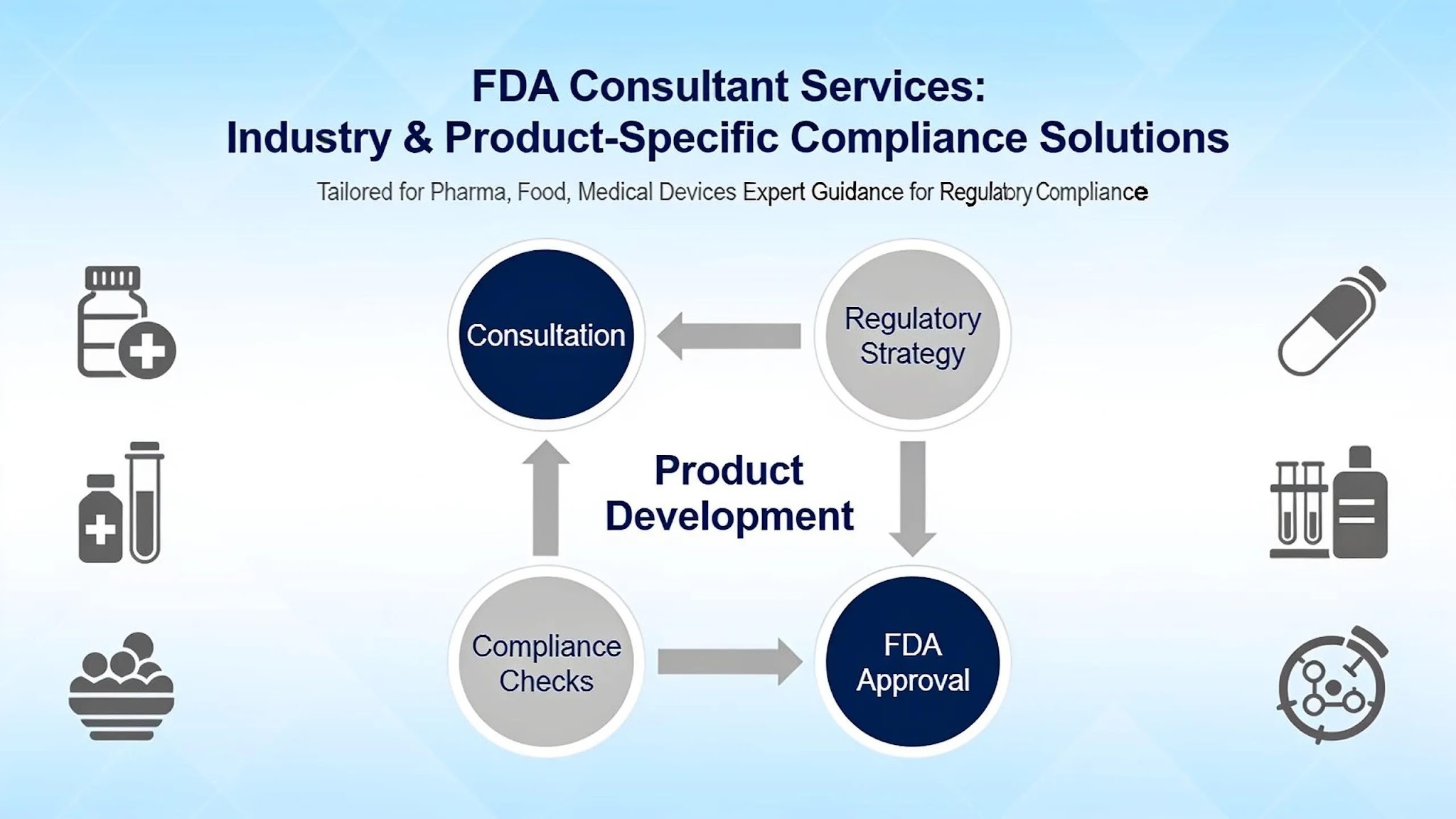
An FDA consultant reviews products, ingredients, and marketing materials before they reach the market, catching compliance problems while they are still cheap to fix. We built our FDA compliance consulting services to be industry- and product-specific, because a supplement formula and a cosmetic label face entirely different regulatory tests. Generic advice creates blind spots; tailored review closes them.
Ingredient review sits at the center of this work. We examine a product’s formulation as it currently stands and determine whether it can be legally marketed without further regulatory approval. Skip this step, and a company risks launching a product that actually requires premarket clearance. That is a costly discovery to make after production runs.
Labeling review matters just as much. FDA labeling regulations run detailed and dense, covering everything from claim substantiation to required disclosures. Many companies bring in consultant-level review specifically to confirm their labels meet these requirements before printing commits them to a design that draws an FDA objection.
What Background Do FDA Consultants Typically Have?
Consulting teams often include professionals with direct, firsthand experience inside FDA processes. That inside perspective gives them a practical read on how the agency actually applies its own rules, not just what the regulations say on paper.
Is a Consultant Review the Same as Legal Advice?
No. Consultant review addresses product and labeling compliance from a regulatory-practice standpoint. Legal advice from a food and drug attorney covers matters like enforcement exposure and FDA legal counsel on litigation risk. Understanding this regulatory consultant vs lawyer distinction helps founders decide which service, or which combination, their situation demands.
What Extra Protection Does an Attorney Provide?
An attorney supplies legal protections that a regulatory consultant cannot: privileged communications, litigation-ready strategy, and authority to represent a business in enforcement proceedings. A food and drug attorney builds compliance into a product from day one, rather than reacting to a crisis after the fact.
Our firm reviews products and marketing materials across the food, dietary supplement, cosmetic, and OTC drug industries. We do this work at the outset, before a label ships or a campaign launches, so compliance gaps never become enforcement targets. That review covers ingredient composition, label claims, and marketing content, including websites, brochures, and video advertisements.
FDA legal counsel extends across every FDA-regulated product category we serve, and it does not stop at pre-market review. Our counsel follows a product through its full lifecycle, from formulation and labeling decisions through any enforcement action the FDA initiates. That continuity matters: the attorney who reviewed a label understands the regulatory reasoning behind it and can defend that reasoning if a dispute arises later.
Why Does Regulatory Knowledge Matter in Litigation?
Litigation and settlement outcomes hinge on how well counsel understands the controlling regulatory requirements and how the FDA applies them in practice. A business that treats regulatory review as a checkbox exercise often discovers, during a dispute, that its own record does not support its position. Attorneys who built the compliance record from the start carry that institutional knowledge directly into the fight.
Privilege and Authority: The Legal Difference
The regulatory consultant vs lawyer distinction comes down to protection and authority. Consultants offer valuable operational guidance, but they cannot assert attorney-client privilege or represent a company in formal proceedings. An attorney does both, giving a business a defensible paper trail and a legal advocate in one relationship. When the agency makes contact, an experienced FDA warning letter response strategy can mean the difference between a resolved inquiry and an escalating enforcement action.
When Might a Consultant Be Enough?
A regulatory consultant vs lawyer decision often comes down to what stage a business occupies. Routine compliance tasks rarely require a courtroom-ready strategy. Some do.
Because the FDA relies heavily on companies to self-regulate, the agency expects businesses to build their own internal policies and process controls long before any enforcement letter arrives. This reality means much of the compliance burden sits on the company itself, not on outside counsel. For founders and compliance leads managing day-to-day operations, a consultant often fills this gap well. We provide FDA registration and listing services alongside other regulatory offerings that support this kind of routine, ongoing compliance work.
Can a Consultant Handle FDA Disputes Alone?
Generally, no. Consultants play a supporting role rather than a standalone one when disputes escalate. Attorneys typically bring consultants in during the discovery and trial stages, using their technical knowledge to strengthen a legal strategy rather than replace it.
What Does a Consultant Contribute to a Legal Matter?
Consultants may render reports and testify at trial, offering technical findings rather than legal argument. That distinction matters: technical expertise informs a case, but it does not substitute for legal representation when liability, penalties, or litigation strategy are on the line.
A consultant fits well for:
- Ingredient and label reviews before product launch
- Registration and listing filings
- Ongoing internal compliance monitoring
Once a warning letter, seizure, or litigation enters the picture, the calculus changes. That is the point where food and drug attorney support, backed by dedicated FDA legal counsel, becomes the safer path forward.
How Do Costs and Engagement Models Differ?
Consultants usually work on defined projects: a single label review, a registration filing, or a periodic compliance audit, often priced as a flat fee or a scoped engagement. Attorneys more often bill hourly for advisory work, with flat fees reserved for well-defined deliverables such as a label review or a warning letter response, and ongoing relationships structured as retainers.
The practical takeaway is that cost follows risk. Routine, repeatable compliance tasks are usually the most affordable to delegate, and a consultant handles them efficiently. Matters carrying legal exposure justify attorney rates because the deliverable is not just the work product but the privilege and representation authority that come with it. Budget for both, and match the spend to the exposure.
How Should You Decide Between the Two?
The decision hinges on what stage a product occupies and how much legal exposure a company faces. Early-stage formulation questions, label reviews, and marketing checks often call for a regulatory consultant vs lawyer comparison before any dollar gets spent. Once enforcement risk, litigation, or contract disputes enter the picture, the calculus shifts toward a food and drug attorney who can act on the company’s behalf with legal authority a consultant simply does not hold.
Use this matrix to match common situations to the right adviser.
| Situation | Consultant | Attorney | Both |
| Routine label or ingredient review | Yes | Optional | |
| New product formulation questions | Yes | ||
| FDA registration and listing filings | Yes | ||
| Warning letter or FDA 483 received | Yes | Often | |
| Import detention or seizure | Yes | ||
| Litigation or liability exposure | Yes | Often | |
| Building an ongoing compliance program | Yes | Ideal |
Our firm’s own FDA legal counsel services illustrate this range. We handle everything from ingredient reviews to label reviews, FDA registration, and marketing reviews, meeting clients wherever they sit in the development or manufacturing timeline. That breadth matters because compliance needs rarely stay static. A start-up that only needs a label reviewed today may need warning-letter defense next year.
Do Larger Firms Combine Legal and Scientific Expertise?
Some food and drug law practices pair attorneys with in-house scientists to strengthen product submissions and ongoing compliance. This combination helps companies bring products to market and, just as important, keep them there once regulators start paying attention.
What Should a Founder Do First?
Start with a direct conversation rather than guessing. A quick list helps frame the call:
- Identify whether the issue involves formulation, labeling, or marketing review
- Flag any pending FDA correspondence, import alerts, or recall concerns
- Note upcoming launch dates that create time pressure
Contact our FDA attorneys seven days a week, and we aim to respond within 24 hours. Companies weighing their options get an answer quickly rather than waiting on a decision alone.
FAQ
What is the main difference between an FDA consultant and a food and drug attorney?
An FDA attorney provides legal representation under attorney-client privilege, including warning letter responses and enforcement defense. A consultant offers regulatory guidance on compliance but lacks authority to represent businesses before FDA in disputes.
Can an FDA consultant represent a business during an FDA enforcement action?
No. Consultants lack the authority to negotiate with FDA’s legal division or defend companies facing enforcement action. Only FDA legal counsel asserts privilege and handles these disputes directly with the agency.
Why might a company need both an FDA attorney and a consultant?
Start-ups scaling quickly benefit from combined perspectives working in coordination. Attorneys handle legal exposure and enforcement defense, while consultants catch formulation and labeling issues early, before products reach the market.
Are conversations with an FDA consultant confidential?
Consultant communications are confidential by contract, but they are not protected by attorney-client privilege. When a consultant works at the direction of counsel, some protections may extend to that work. If a matter carries legal exposure, route sensitive questions through an attorney first.
How much does it cost to hire an FDA consultant or attorney?
Costs depend on scope rather than title. Consultants typically charge flat project fees for defined deliverables like label reviews or registrations. Attorneys commonly bill hourly for advisory work, with flat fees for defined deliverables and retainers for ongoing representation.
Who should I call first after an FDA warning letter or import detention?
Call a food and drug attorney first. Warning letter responses carry strict deadlines and legal consequences, and early statements to the agency shape the entire matter. A consultant can support the technical work, but counsel should lead the response.
Conclusion
The distinction between an FDA consultant and a food and drug attorney reflects the difference between guidance and legal protection. Consultants offer valuable regulatory expertise for routine, pre-market compliance work. A specialized food and drug attorney provides the privileged legal strategy your business requires during product development, agency interactions, and enforcement disputes.
Shehadeh Giannamore, PLLC combines both dimensions, delivering authoritative regulatory knowledge alongside vigorous legal advocacy, so your FDA-regulated products achieve compliance while your business interests stay protected at every stage. If you are weighing which adviser your situation requires, reach out for a direct conversation about your product, your timeline, and your exposure.