
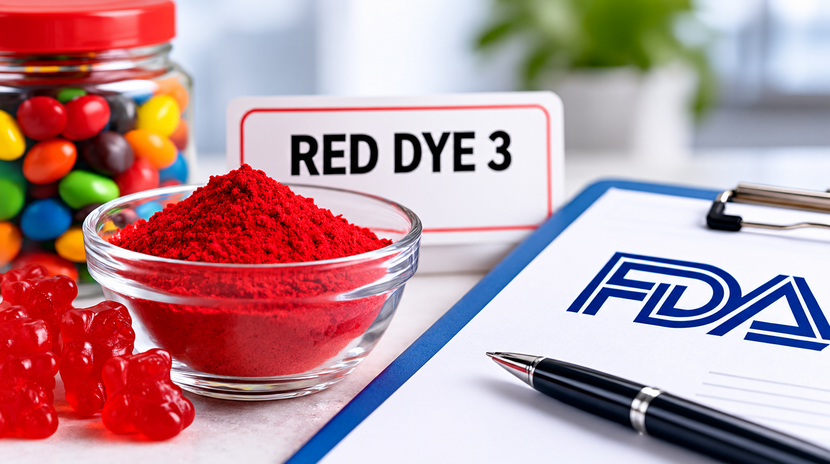
Red Dye 3 is on the way out of food and ingested drugs in the United States, but it is not already gone from every shelf. FDA has ordered an end to FD&C Red No. 3 in those uses. Food manufacturers have until January 15, 2027 to reformulate. Makers of ingested drugs have until January 18, 2028. Shehadeh Giannamore, PLLC advises food, beverage, dietary supplement, and cosmetic companies on ingredient and label rules, including color additives.
FD&C Red No. 3 is the certified name. Red Dye 3, Red Dye No. 3, and erythrosine are other names for the same color. It is a synthetic dye that produces a bright cherry red. FDA says it has been used in candy, cakes and cupcakes, cookies, frozen desserts, frostings and icings, and ingested drugs.
A product made before the applicable date can still be in the market after that date. The cutoff is manufacturing, not the day a shopper finds the package. Seeing “Red 3” on a label in 2027 does not, by itself, mean the company missed the order.
Is Red Dye 3 banned?
FDA will no longer allow FD&C Red No. 3 in food or in ingested drugs. The agency issued orders on January 16, 2025 and August 5, 2026 revoking those authorizations. Until the reformulation date for that use, the color can still be used as the order allows. After that date, new manufacturing of those foods or ingested drugs with this color is outside the listing.
The legal hook is the Delaney Clause. Congress added it in 1960 in the Color Additive Amendments. It tells FDA it may not authorize a food additive or color additive that has been found to induce cancer in humans or animals. FDA says a 2022 color additive petition presented data that high levels of FD&C Red No. 3 caused cancer in male laboratory rats through a hormonal mechanism. FDA also says studies in other animals and in humans did not show that effect, and that there is no evidence the color causes cancer in humans. The Delaney Clause does not ask FDA to weigh that distinction once the animal finding is made. FDA says the data do not raise a safety concern for people, and it is still revoking the uses.
This is not a new study dropped on industry in 2025. In 1990 FDA denied a petition to permanently list the color for cosmetics and topical drugs because of the rat data. In 1992 FDA said it intended to revoke the food and ingested-drug listings (57 FR 16702) and then did not. The 2025 and 2026 orders are the step the agency described and postponed.
Other countries still allow the color under the name erythrosine. FDA names Canada and Europe as examples. A formula that is lawful there is not automatically lawful here after the U.S. dates.
What red dye is banned?
The red dye FDA is removing from food and ingested drugs is FD&C Red No. 3. Searches for “what red dye is banned” and “red food dye ban” are about this color. They are not a finding that every red color additive is unlawful.
A different certified color stays available only if its own regulation still lists that use. FDA approves color additives use by use. A listing names the products, any maximum amount, the identity and specifications, and whether the batch must be certified. If the regulation does not list the use, the color is not approved for it.
Do not swap the name on the label and keep the same dye. Calling FD&C Red No. 3 a “natural color,” a fruit name, or erythrosine on a U.S. food label does not keep the use inside the order. Erythrosine is the same substance.
Food and ingested drugs are on different dates
The order is easy to misread as one deadline. FDA split the dates by use.
| Use | Order | Reformulate by |
| Food | January 16, 2025 order | January 15, 2027 |
| Ingested drugs | August 5, 2026 order | January 18, 2028 |
| Product already manufactured | May remain on the market after the date | No extra sell-by date in FDA’s Red No. 3 page |
Ingested drugs are drugs that are swallowed. FDA’s page does not set these two dates for cosmetics. The 1990 decision already refused a permanent listing for cosmetics and topical drugs. A company still using the color in a topical product should check the listing that applies to that product, not assume the food date covers it.
What FDA color additive rules require
Color additives are not ordinary ingredients that a company can use because they are common. Section 721 of the Federal Food, Drug, and Cosmetic Act requires FDA approval before a color additive is used in food, drugs, or cosmetics, and before it is used in some medical devices that contact the body for a significant time.
A company that wants a new color, or a new use of a listed color, submits a petition. FDA looks at how much people are likely to eat or apply, the intended use, how the color is made, and its physical and chemical properties. If the data support the use, FDA publishes a regulation. That regulation is the approval.
Certified colors, including FD&C Red No. 3, are batch-certified. Each batch has to meet the identity and specification in the regulation. Using a color that was never certified for that batch, or using it in a product the listing does not cover, can make the food adulterated. Adulterated food can be refused at import, seized, or named in a warning letter.
The Delaney Clause is a limit on that approval. If appropriate tests show that a color additive intended for ingestion induces cancer in people or animals, FDA treats that use as unsafe. The agency does not keep the listing because the rat dose was high or because human studies did not repeat the finding. That is why FDA can say it sees no human cancer evidence and still revoke the food and ingested-drug uses.
FDA also keeps reviewing colors after they are listed. The food company, not FDA, is responsible for making sure what it sells meets the current regulation. A listing that was valid when the package was designed can lapse on the date in a later order.
How the ingredient statement has to name the color
While a food still contains FD&C Red No. 3, the ingredient statement has to declare it. FDA allows “FD&C Red No. 3,” “FD&C Red 3,” or “Red 3.” A coined color name is not one of those options.
After reformulation, the ingredient statement has to name the replacement, and only if that replacement is listed for that food. Lakes and dyes are not interchangeable on a label just because both look red. The declaration follows the specific color that is in the batch.
Labels, websites, and ads are a separate problem from the formula. Removing the dye and leaving “made with Red 3” or a cherry-color claim that implies the old ingredient is still there is a misbranding issue. An FDA label review is how those words get checked against the formula you actually fill.
How a phaseout works, from the trans fat orders
FDA has used a dated cutoff before. Partially hydrogenated oils, the main industrial source of artificial trans fat, lost GRAS status. Companies had a compliance window. Product made under the old rule was not treated as instantly illegal on announcement day. The Red 3 orders follow that shape. There is an order, then a manufacturing date, then enforcement against product made after the date.
The 2013 step was a tentative determination, described in FDA acts to ban trans fat in foods. It was not the final ban, and it is not the Red 3 order.
FDA later issued a final determination that partially hydrogenated oils were not GRAS, with a compliance date in June 2018. FDA bans trans fats walks through that order. Read it as history of a different ingredient. The June 2018 date does not apply to Red 3.
The practical likeness is the work, not the statute. Trans fat was a GRAS determination. Red 3 is a color-additive listing revoked under the Delaney Clause. Both force a formula change, a new ingredient line, and a check of imported product. Importers do not get a different U.S. date because the foreign plant still uses erythrosine.
What to change before the manufacturing cutoff
Start with the formula, not the marketing line. List every SKU that declares Red 3, FD&C Red No. 3, or erythrosine, including frostings, inclusions, and drugs that are swallowed. Split food from ingested drugs so the 2027 date and the 2028 date are not blended into one project plan.
Pick a replacement that a current color-additive regulation allows in that food or drug, at that level. Then match the ingredient statement, any website that repeats the ingredient list, and the spec you send to a copacker or foreign supplier. An FDA ingredient review is the check on whether the replacement is listed for that use, not only whether it looks red.
Keep batch records that show the last date you manufactured with FD&C Red No. 3. FDA’s page says product made before the effective date can remain in the market. If you cannot show when the batch was made, you cannot use that allowance.
If a shipment is still on the water on the cutoff date, the question is when it was manufactured, not when it arrives. A spec that still says erythrosine will keep producing product you cannot sell here.
Questions about the red food dye ban
Is Red Dye 3 banned in food right now?
FDA has revoked the authorization, and food manufacturers must stop using FD&C Red No. 3 by January 15, 2027. Food made before that date can still be sold after it. The color is not described as instantly illegal on the day of the 2025 order.
What red dye is banned?
FD&C Red No. 3, also called Red Dye 3 or erythrosine, is the red color FDA is removing from food and ingested drugs. Other red colors are lawful only when their own FDA listing covers that use.
When is the deadline for drugs?
Manufacturers of ingested drugs have until January 18, 2028. That date is later than the food date. It comes from FDA’s August 5, 2026 order.
Does FDA say Red Dye 3 causes cancer in people?
No. FDA says the petition data showed cancer in male laboratory rats by a hormonal mechanism, that other animal and human studies did not show the same effect, and that there is no evidence it causes cancer in humans. The Delaney Clause still requires FDA to treat the animal finding as a bar on authorization.
How must the color appear on a food label?
As “FD&C Red No. 3,” “FD&C Red 3,” or “Red 3.” After you remove it, the label has to name the color that replaced it, and that color has to be approved for the food.
Can a product sold in Europe still use erythrosine in the United States?
Not after the U.S. manufacturing date for that use. FDA notes that other countries allow erythrosine. U.S. color-additive listings are separate.