
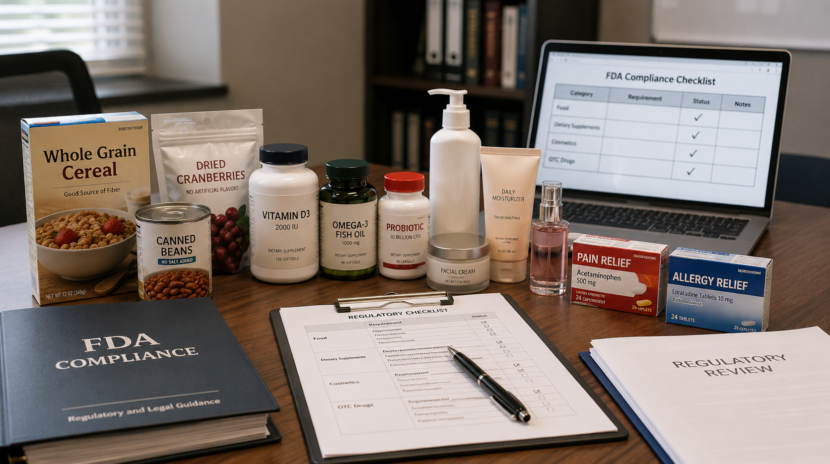
Navigating FDA requirements is essential for companies that make or sell food, dietary supplements, cosmetics, or over-the-counter (OTC) drugs. Meeting those rules protects consumers and preserves trust in the marketplace. This guide breaks down the core obligations for each product group—classification, labeling, and audits—and explains how legal and regulatory support can help streamline compliance. We cover FDA product categories, label requirements, practical compliance steps, and how legal counsel can assist at each stage.
How does the FDA classify food, supplements, cosmetics, and OTC drugs?
The FDA places products into four broad categories: foods (including beverages, medical foods, and dietary supplements), cosmetics, medical devices, and drugs (OTC drugs and prescription drugs), each governed by its own regulatory framework. Correct classification determines which rules apply for safety testing, labeling, marketing, and recordkeeping. Getting the category right is the first, most important step to staying within the law.
How does the FDA distinguish food from dietary supplements and cosmetics?
The FDA looks at a product’s intended use to decide its category. Food is consumed for nutrition; dietary supplements are intended to supplement the diet and can include vitamins, minerals, herbs, or botanicals; cosmetics are meant for cleansing or beautifying. While all categories must meet safety expectations, their labeling and marketing rules differ substantially. Accurate classification helps avoid misbranding, consumer confusion, and enforcement actions.
Proper classification reduces legal risk and clarifies which regulatory pathway applies to a product.
Dietary Supplement Regulations: Labeling, Reporting, and the FDA Framework
Federal law treats many dietary supplements as a form of food and sets specific label requirements and adverse event reporting processes. The FDA enforces those requirements to protect public safety.
Current regulatory guidelines and resources to support research of dietary supplements in the United States, RL Bailey, 2020
What are the regulatory consequences of misclassification?
Misclassifying a product can trigger enforcement, including fines, recalls, or forced relabeling. Labeling a food as a supplement—or vice versa—can mislead consumers and create health risks, which draws FDA scrutiny. Companies should build internal controls and classification checks into product development and marketing workflows to ensure compliance with classification standards and reduce exposure to enforcement actions.
What federal labeling rules apply across food, supplements, cosmetics, and OTC drugs?
Labels are a primary consumer protection tool and a major focus of FDA oversight. Each product category has distinct labeling obligations that inform ingredient disclosure, usage directions, safety warnings, and permissible claims.
What labeling rules apply to dietary supplements and their claims?
Dietary supplements must include a Supplement Facts panel listing serving size, ingredients, and amounts. Any claims about health benefits must follow FDA and FTC standards and avoid misleading or unverified therapeutic assertions. Proper labeling—clear ingredient lists, accurate claims, and required disclaimers—helps keep products on the market and maintains customer confidence.
How do cosmetic labeling rules differ from food and OTC drug labels?
Cosmetics are not required to carry nutrition information, but manufacturers must list ingredients (including common allergens) and avoid claims that imply the product treats or alters body structure or function. That distinction separates cosmetics from drugs and limits the kinds of health claims that are permissible. Staying within those boundaries prevents products from being regulated as drugs.
How can companies ensure compliance for dietary supplements and food products?
Proactive systems—ingredient reviews, clear documentation, staff training, and routine audits—are the foundation of a reliable compliance program. Companies should create repeatable processes for label review, adverse event tracking, and regulatory monitoring to reduce the chance of violations.
What are the steps for conducting FDA compliance audits in these product categories?
- Preparation: Compile regulatory files—labels, ingredient lists, manufacturing records, and any safety or test data.
- Assessment: Compare current products and processes against applicable FDA rules to identify gaps.
- Documentation: Keep organized records of testing, formulations, supplier information, and compliance activities.
- Corrective Actions: Address identified issues promptly and document the fixes, timelines, and follow-up checks.
Following these steps helps companies respond to regulatory changes and demonstrate due diligence if issues arise.
How does clarity around Good Manufacturing Practices (GMP) affect compliance?
Clear, documented GMPs are essential to consistent product quality and safety. GMPs reduce manufacturing errors, contamination risks, and variability, all of which lower the chance of non-compliance. Demonstrating strong GMP controls also improves credibility with regulators and customers.
What FDA requirements and compliance risks apply to OTC drugs and cosmetics?
OTC drugs and cosmetics are subject to different expectations. OTC drugs usually face stricter scrutiny for safety and efficacy, while cosmetics must avoid drug-like claims—each category carries its own enforcement risks that manufacturers must understand.
How are OTC drugs regulated and classified under FDA rules?
OTC drugs are evaluated by active ingredient and intended use; many follow monograph pathways or require specific approvals. Because they make therapeutic claims, OTC products typically need stronger evidence of safety and effectiveness than supplements or cosmetics. Those classification and approval differences underscore the greater regulatory complexity for OTC drugs.
International differences in classification and approval pathways further complicate global marketing strategies.
Global Over-the-Counter Drug Regulations: Classification, Approval, and Challenges
A major challenge in OTC regulation is that classification rules and approval routes vary across jurisdictions, creating hurdles for manufacturers that sell internationally.
Navigating Global Regulatory Divergence in Over-the-counter Drugs: Addressing Emerging Risks and Harmonization Challenges, SB Chauhan, 2025
What enforcement actions can the FDA take for cosmetic noncompliance?
The FDA can issue warning letters, request recalls, or pursue seizures and injunctions when cosmetics are labeled or marketed in violation of the law. Noncompliance can lead to legal costs, reputational harm, and interrupted sales. Ongoing monitoring and rapid corrective action are effective ways to reduce those risks.
How can legal and regulatory consulting help with FDA compliance for food, supplements, cosmetics, and OTC drugs?
Regulatory and legal consultants can clarify which rules apply to your products, help with classification and labeling decisions, and support responses to FDA inquiries. Bringing focused regulatory counsel into product development and launch planning reduces uncertainty and shortens the path to compliant market entry. For tailored assistance, consider specialized FDA regulatory consulting.
These services are particularly valuable for food companies navigating complex ingredient, labeling, and safety requirements.
FDA Regulatory Consultants: Legal Support for Food Product Compliance
Regulatory consultants often advise on engaging outside specialists and may provide testimony when needed. For food products, these advisors can bridge technical and legal workstreams to support compliance efforts.
What are the benefits of combining legal advice with regulatory consulting?
Pairing legal counsel with regulatory support creates a comprehensive view of risk and compliance—covering legal obligations, operational controls, and commercial considerations. This integrated approach helps companies anticipate enforcement priorities, streamline processes, and reduce costly rework.
How do compliance case studies show successful FDA navigation?
Case studies highlight concrete steps companies have taken—revising labels, tightening supplier controls, and strengthening documentation—to meet FDA expectations. These real-world examples reveal practical strategies that can be adapted across industries.
Where can you find updated FDA enforcement reports and regulatory changes for 2024–2026?
Official FDA channels are the best source for the latest enforcement reports, guidance documents, and rule changes. Subscribing to FDA updates, monitoring industry bulletins, and working with regulatory counsel will help companies stay current with developments through 2024–2026.
To discuss your specific situation, please contact us.
Frequently Asked Questions
What are the potential consequences of not complying with FDA regulations?
Non-compliance can lead to fines, product recalls, warning letters, and litigation. Companies may suffer reputational damage and lost sales, and in severe cases the FDA can seek product seizures or injunctions. Staying current with requirements and documenting compliance activities are key to avoiding those outcomes.
How can companies prepare for an FDA compliance audit?
Preparation starts with organized records: labels, ingredient sources, testing results, and production logs. Conduct an internal review to identify gaps, train staff on procedures, and correct issues before an audit. Clear documentation of corrective actions demonstrates a commitment to compliance.
What role do third-party labs play in FDA compliance?
Independent labs provide objective testing for identity, potency, contaminants, and stability—data that supports label claims and safety assessments. Third-party testing helps validate compliance before products reach consumers and can be critical evidence in regulatory reviews.
Can small businesses afford legal and regulatory consulting services?
Consulting can be an investment, but many providers offer scalable options to fit smaller budgets. Early or targeted consulting help can prevent costly mistakes later, making it a cost-effective choice for many small businesses.
What are Good Manufacturing Practices (GMP) and why do they matter?
GMPs are guidelines that ensure consistent product quality—from sourcing raw materials to packaging. Following GMPs reduces contamination and variability, supporting safety and regulatory compliance. Strong GMPs also strengthen customer trust and help when defending product quality in regulatory reviews.
How often do FDA regulations change and how can businesses stay updated?
FDA policies evolve with scientific advances, safety findings, and public health priorities. Companies should monitor the FDA website, sign up for regulatory alerts, join industry groups, and work with regulatory counsel to track relevant changes and update controls accordingly.
What should companies keep in mind about marketing claims on dietary supplements?
Health-related claims for supplements must be truthful, substantiated, and within FDA and FTC guidelines. Avoid therapeutic or disease claims that would classify a product as a drug. Clear labeling—such as a proper Supplement Facts panel—and conservative, evidence-based marketing reduce regulatory risk.
Conclusion
Complying with FDA rules for food, dietary supplements, cosmetics, and OTC drugs protects consumers and preserves market access. Understanding classification, labeling, manufacturing controls, and audit readiness helps companies minimize risk and improve product credibility. Working with legal and regulatory advisors can speed the path to compliant launches and provide practical support when issues arise. Explore our resources to learn more about maintaining FDA compliance.